When work is no longer
the central distribution mechanism
It is not the smartest AI that will decide prosperity in 2040, but who owns the infrastructure the machines run on and how their returns are shared. This picture of the future shows what matters and how you can follow progress month by month.
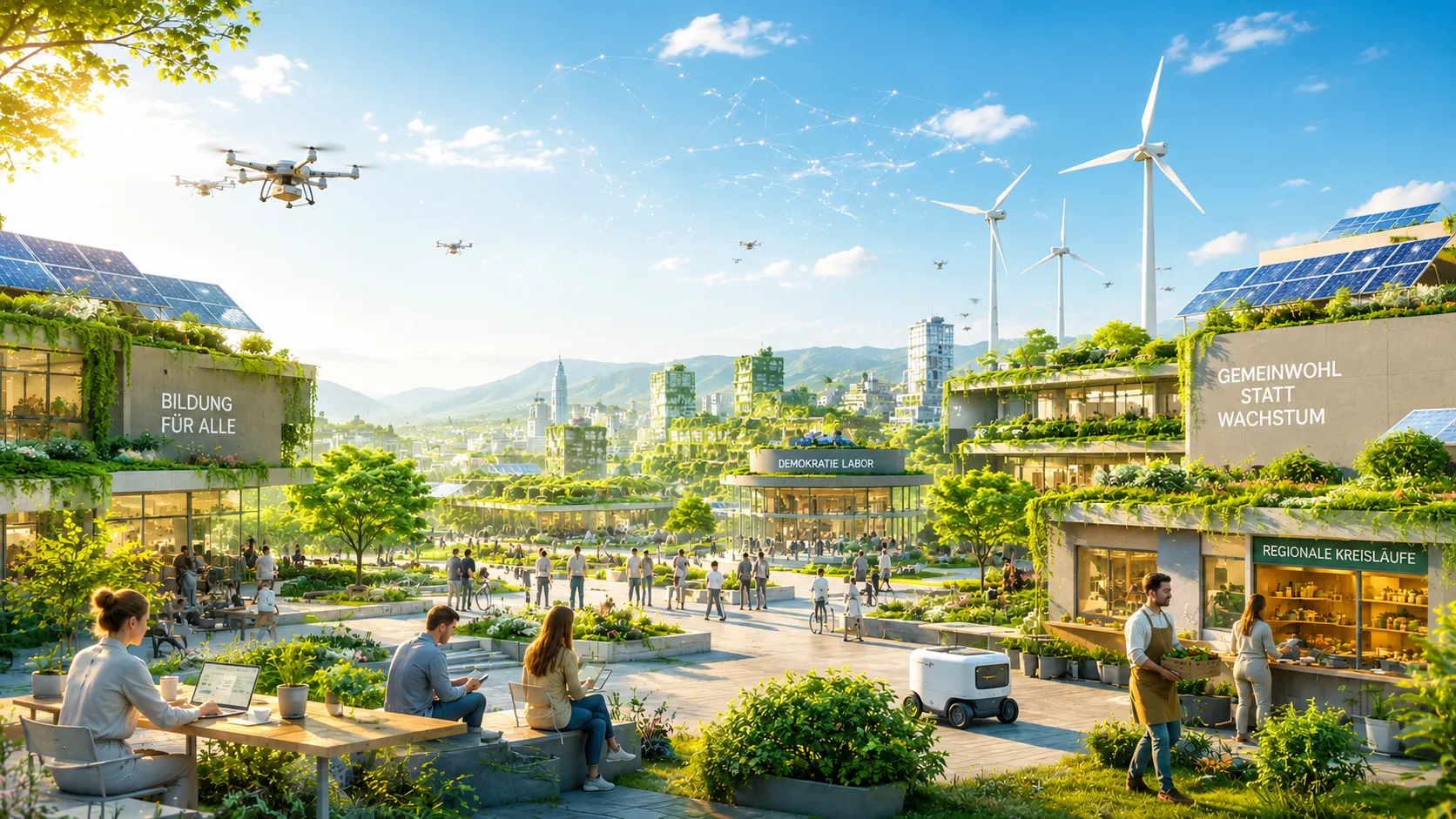
How we might live in 2040.
Paid work is an option, not an obligation. The welfare state no longer finances itself from wages but from capital, data and externalities. The value creation of artificial intelligence no longer belongs solely to the corporations that build it. This is what that economy looks like across ten areas. This is our assessment, not a forecast. Click on an area to see the basis on which it rests.
Today around half of state revenue depends on wages. This base shrinks as machines take over more value creation. In 2040 wage taxes still carry around a third; the rest comes from capital income, levies on CO2 and a levy on data and AI value creation.
Capital is more mobile than labour. Without international coordination the tax base moves away instead of being captured.
Income was almost always pay for working time. If a growing share of value creation happens without working time, livelihoods need more legs to stand on. In 2040 there are three: basic provision for housing, health, education and mobility, a capital dividend from an ownership fund and a voluntary job guarantee.
The capital dividend makes livelihoods dependent on returns in the capital markets.
If machines carry the larger share of value creation, access to ownership decides the share of prosperity, no longer work performance. In 2040 sovereign funds and cooperatives hold significant stakes in data centres, grids and foundation models. This is participation with payouts, not nationalisation.
A state that holds stakes in the companies it regulates has a conflict of interest. Only disclosure can defuse it.
Paid work provided income, daily structure and recognition at the same time. The market will pay for less of this, yet no less is needed. In 2040 care work, the commons, art and research count as recognised contributions, with pension entitlements.
It remains open who decides which activity counts, and what happens to those who fall through this grid.
In-demand skills shift every five to ten years, yet the education system is built for learning once, when young. In 2040 every adult has a learning account with funded time credits and no age limit. Retraining at 45 or 55 is the norm.
An account does not solve a motivation problem. Someone who sees no prospects at 55 will not use it.
The more complex the proposals, the greater the temptation to leave decisions to experts or machines. That costs legitimacy, the scarcest resource in an upheaval. In 2040 citizens' assemblies chosen by lot prepare complex proposals, machines supply arguments and impact assessments, and the ballot box decides.
Whoever controls the selection of a citizens' assembly controls its outcome.
When the same models help decide on administrative rulings, diagnoses and loans, controlling them is no longer purely a market question. In 2040 there are therefore two layers: auditable foundation models held in common for administration, justice and science, and private models for the market. These are steered through transparency duties and levies, not bans.
Public models usually lag a generation behind private ones.
The number of very old people rises sharply by 2040, while the number of people in work falls. That is demography, not a forecast: the cohorts concerned have already been born. In 2040 pensions combine pay-as-you-go and a capital stock, and care is part of the job guarantee: trained, recognised and paid.
If pensions and care depend on the same capital stock, a long market slump hits both at once.
A levy on CO2 makes damage more expensive and brings in revenue just when wage taxes fall away. This double effect makes it politically feasible. In 2040 growth is decoupled from resource use because value creation has shifted, not because people consume less.
Without redistribution the levy hits lower incomes harder. Then it is scrapped before it takes effect.
For many people their job was the answer to the question of who they are. As it loses weight, a gap opens that no payout can fill. In 2040 the question is no longer “What do you do for a living?” but “What are you working on right now?”.
This is the most optimistic assumption in this picture and the hardest to measure. Loss of status without replacement is just as possible.
Possible turning points along the way
No vision of the future materialises all at once. These milestones show what tips and when, and how to tell along the way whether the trajectory is on course.
AI agents are beginning to manage supply chains and trading venues, under growing state oversight. From 2028 it will become clear whether the vast investments in computing power yield first returns or leave mainly write-downs.
Beijing's top-down scaling risks overheating. Over-investment in robotics and chips could lead to a deflationary price war, as once happened with solar panels and electric vehicles. Whoever controls the component chain steers this price decline; whoever holds only the end product or the model is overrun by it.
Revenues from AI services must cover write-downs on chips that become obsolete within a few years. Should that fail, a sharp revaluation of AI infrastructure looms. Robots that disappoint outside controlled environments, and unresolved liability questions, deepen the disillusionment.
Labour shortages break political resistance to automation. Of more than five million robots worldwide, a disproportionate share runs in European factories, hospitals, and logistics centres. What remains open is who builds these machines: Europe itself, or Chinese manufacturers.
The West dominates the most capable models and the capital markets. China achieves around 70 per cent self-sufficiency in mature chip equipment and deploys over 1.5 million humanoid robots in factories and logistics. Audit requirements for AI models become the norm. Decoupling persists; it is not temporary.
China no longer exports products but operating systems. Digital payment and agent systems run in dozens of emerging economies. South-East Asia, with 700 million people, becomes the most important user region. India is building a third centre of gravity with its own sovereign digital system.
When machines account for a growing share of value creation, the way people participate must be rethought. Every region will find its own answer. Radically redesigned education systems featuring AI-powered learning from primary school onwards, alongside early Capital Dividend models, point to where this is headed. What would it mean for you if your income were no longer determined solely by your own labour?
We consider three movements very likely: the tax shift, the ownership question and the economic recognition of care work. Three things remain open: the Speed, the global dimension and the question of purpose.
That is why the Globalance Intelligence Index continually measures how far this path has actually been travelled. See the index →
One technology, four paths
The same artificial intelligence meets four different countries. How they deal with it decides who wins in 2040.
USA
The USA enters the economy that is coming as the leading AI power. Its foundation: the deepest capital markets in the world, the largest stock of computing power and a flexible labour market.
To the country scenario →China
China enters the economy that is coming as a manufacturing superpower and a rising AI power. It has a leading robot density, a vast STEM talent base and a state that sets the course as the central actor in capital and data.
To the country scenario →Switzerland
Small country, open economy, direct democracy: Switzerland has the best conditions to shape the transformation, provided it sets the right course in time. This is its scenario, told through the pillars, the seven areas, the Globalance Intelligence Index Switzerland and the Tanner family.
To the country scenario →Germany
Germany enters the economy that is coming as Europe's largest economy, the world's leading exporter and a developed welfare state. A strong industrial base, a deep engineering culture and a broad base of mid-sized companies form the foundation.
To the country scenario →The tax shift is very likely. The mathematical logic of a shrinking wage-tax base can be delayed by political means, but not repealed. The open question is: how painful will the transition be.
The question of ownership will be raised. When roughly one third of the S&P 500 rests with seven tech giants, political pressure builds. The only question is whether the response will be constructive (sovereign funds, co-operatives) or destructive (nationalisation, capital flight).
Care work will gain formal economic recognition. Demographics compel every Western society to act. The question is not whether, but how.
Pace: 2040 is a conjecture, not a promise. That is precisely why we use the Globalance Intelligence Index to continuously measure how much of this journey has actually been covered.
Global dimension: The USA and China are developing differently. The disruption is the same everywhere; what differs radically is each country's response: who shares in the new prosperity, and by what means.
The question of purpose: Overcoming the crisis of meaning is an optimistic assumption.