 KI
Germany on the path to 2040
How far society, labour and the state have advanced in transition, calculated per capita.
Germany enters the economy that is coming as Europe's largest economy, an export champion and a well-developed welfare state. On this page you can see where it stands on the way to 2040, measured with the same indicators as the other three countries, and how its 14 pillars are faring.
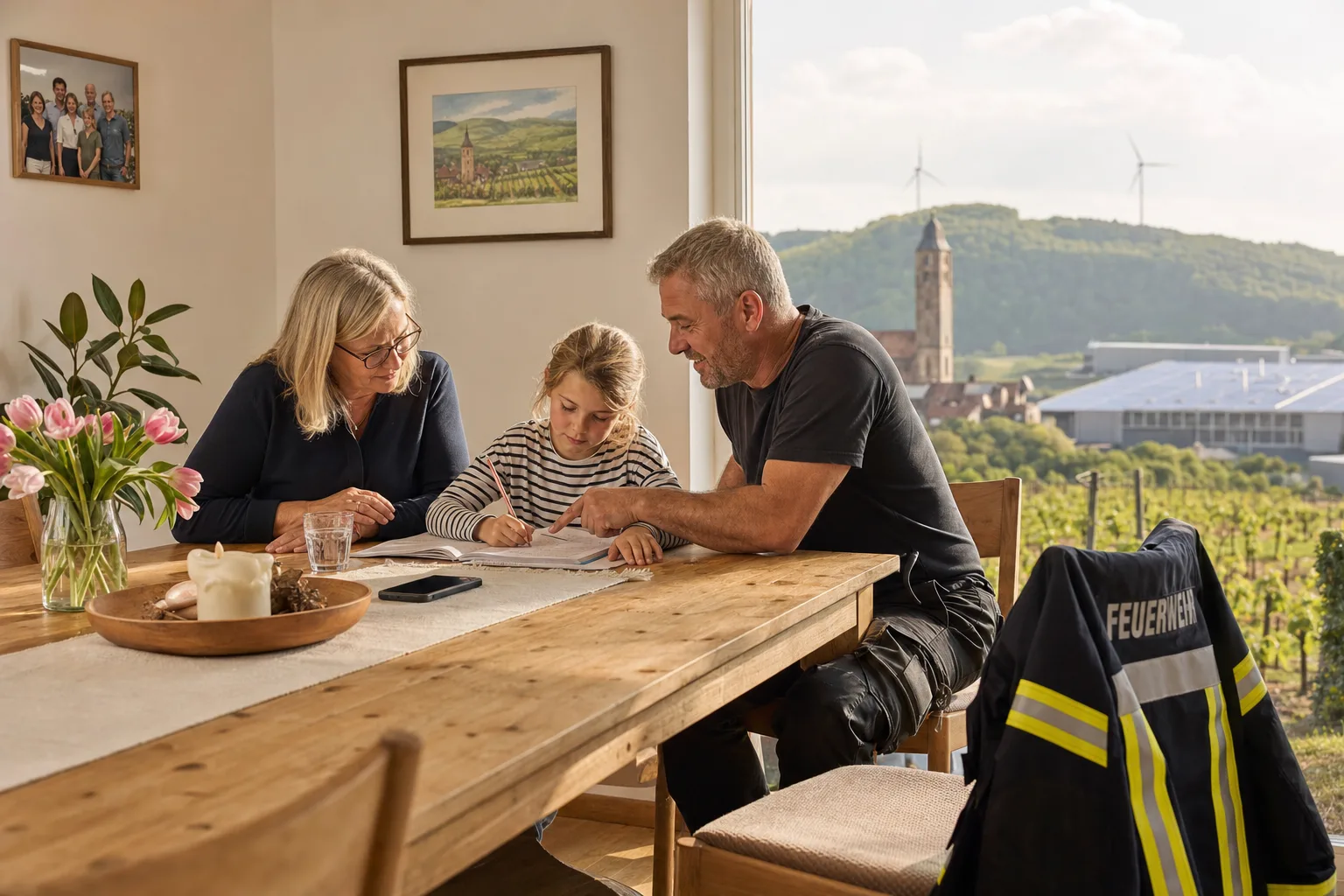
It is May 2040. A family from the Stuttgart region lives in an economy that has little in common with that of 2026. Paid employment is one of several forms of contribution, no longer the only one. The welfare state no longer finances itself from wages alone, but increasingly from capital, data, and externalities. AI value creation no longer belongs exclusively to the hyperscalers in California. Germany holds substantial stakes through an expanded generational capital fund and distributes a dividend from it to all citizens.
A day in the life of the Weber family
Andrea Weber, 52, wakes up in a renovated terraced house in a suburb of Stuttgart. For twenty years she worked as a clerk in order processing at an automotive supplier. When AI systems took over the quoting and invoicing processes in the mid-2030s, her department shrank from forty to eight people. Rather than accept redundancy, she chose the path negotiated by the works council: an eighteen-month retraining programme, funded equally by her employer and a state transformation fund.
Today Andrea works as an 'AI process guide', accompanying the very systems that once replaced her colleagues. She reviews exceptions, trains models with specialist knowledge, and owns quality. She works four days a week. The fifth goes to caring for her mother and volunteering at a neighbourhood centre. Since 2033, this care and voluntary work has been recognised as counting towards her pension.
Her husband Thomas, 55, a toolmaker by trade, stayed in manufacturing. His plant switched from combustion engines to battery and storage systems in the late 2020s. Without that transition, his occupation would have disappeared. The 32-hour week has applied there since 2037, agreed under the collective agreement in exchange for productivity commitments. Thomas uses the extra day in a way he never planned: he leads the local junior fire brigade and teaches fourteen-year-olds how to handle tools. "After a shift I used to be too tired for that," he says.
A notification appears on Andreas's mobile device: the quarterly distribution from the Generationenkapital has arrived, 890 euros per adult. The money comes from the returns of the German Generationenkapital. It was begun in the late 2020s, consistently expanded through the 2030s, and today holds about €1.2tn in stakes in domestic and global technology, energy and infrastructure companies. A portion of the family distribution flows into granddaughter Emma's education account.
Their two adult children took different paths. Jana, 29, works as an engineer at a grid operator, planning lines and storage systems for the region. Her brother Felix, 26, works in care, one of the few structurally resilient growth sectors. Both have held a state-backed investment account since childhood. They work in the new economy and are also co-owners from the outset.
Jana has a daughter, Emma, aged seven. Emma attends a full-day primary school, eight hours a day. The entitlement has existed since August 2026, initially for the first school year and from 2029 for all four primary years. Twice a week Andrea and Thomas collect her. Today, on Wednesday, Emma sits in the fire station after school and watches her grandfather dismantle a pump.
That evening, Andrea votes on whether to build a new AI data centre in the region. A citizens' assembly prepared the decision: people chosen by lot spent months exchanging arguments with experts. The result is clear. Politics has not become less democratic — it has become better informed.
This is what a Wednesday in 2040 looks like. What seems unremarkable here is precisely the point: it works. How it works is the architecture we describe as the Globalance Outlook.
How this world works
By 2040, wages and income tax account for only around 38% of German government revenue, a significantly higher share than in 2026. Three elements absorbed the shortfall: higher taxation of capital income in line with the OECD minimum standard, a meaningful carbon price, and a data levy on the commercial use of AI training data. Germany moved gradually, with initial reforms in the late 2020s and full implementation by the mid-2030s.
Securing a livelihood no longer depends on paid employment alone. Three pillars support it: a reliable Universal Basic Services foundation covering housing, health, education and mobility; a Capital Dividend drawn from generational capital; and a Job Guarantee in care, social and climate-related occupations. A full Universal Basic Income (UBI) never arrived; the debate moved in a different direction.
Germany's generational capital fund today holds approximately €1.2 trillion in equities, infrastructure and AI stakes. Alongside this, the share of households owning equities and funds has risen sharply. Employee ownership schemes and co-operatives have become common among mid-sized firms. Those who work are increasingly also those who own a stake.
Paid employment is one of several recognised forms of contribution. Care work, volunteering, artistic activity and scientific work have been recognised since 2033. They establish pension entitlements and social esteem. Social partnership between trade unions and employers organised the transitions rather than letting them tip into disruption. Collectively agreed full-time hours stand at 32 to 35 per week in many sectors by 2040. A share of productivity gains was passed on as time.
A personal learning account has reshaped the continuing education system. Dual vocational training has been extended to cover digital and AI-related content. Retraining at 45 or 55 is now the norm, not the exception.
Parliamentary democracy has not been replaced but complemented. Citizens' assemblies prepare complex proposals; parliaments and voters still make the decisions. AI helps structure arguments, not reach conclusions. The European AI Act and its German implementation ensure explainability and liability.
Large foundation models in public administration and research have been organised within European data and compute infrastructures since the early 2030s, with GDPR providing the foundation of trust. Private models continue to operate, constrained by data-contribution requirements and clear regulatory rules.
The state pension has become "Pension 2.0": a pay-as-you-go system combined with a funded element from the generational capital fund. Care work is part of the Job Guarantee and paid accordingly. The care crisis of the late 2020s is history.
Care has become part of public infrastructure. Two legal entitlements laid the foundation: one to a nursery place from the first birthday, in force since 2013, and one to full-day primary school provision since 2026. For a long time, qualified staff and places were lacking. By 2040 the gap is closed, because the Job Guarantee pays for childcare and eldercare at the same rate as skilled trades.
Carbon pricing has worked: Germany's per-capita emissions have fallen significantly. Growth is now decoupled from resource consumption through new forms of value creation, not through reduced consumption. The expansion of grids and renewable energy has absorbed the power demand of data centres.
The crisis of meaning of the early 2030s was overcome through new forms of contribution, an expanded mental health infrastructure and vibrant communities. The old question 'What do you do for a living?' has given way to the more open question 'What are you working on at the moment?'
What set the system in motion
This world did not emerge from a single decision. It is the result of a chain of triggers between 2027 and 2035.
a wave of job cuts swept through knowledge work and office roles. Banks, insurers, public administrations, and suppliers shed hundreds of thousands of positions in tasks that AI models could assume. The first structural short-time working schemes and expanded retraining programmes began to emerge.
The demographic gap in the statutory pension system became impossible to ignore. An ever-smaller number of contributors was funding an ever-larger number of retirees. Expanding the generational capital fund shifted from being an exception to being a necessity.
A cross-party resolution in the early 2030s built the generational capital fund into a genuine capital stock. An unusual alliance supported it, because the measure was understood as participation rather than redistribution.
An EU framework for AI sovereignty and a European data levy set the stage for Germany to embed its own mechanisms without placing itself at a disadvantage in the single market.
The crisis of meaning of the early 2030s undermined the old promise that paid employment alone gives life its purpose. The public discourse opened up to other forms of contribution.
What is robust about this story
We are not saying: this is exactly what will happen. We are saying: it could happen, if the right decisions are taken in time.
Three questions remain open: the pace (2040 is an assumption, not a promise), the global dimension (the USA and China are developing differently), and the question of meaning (overcoming the meaning crisis is an optimistic assumption). It also remains to be seen whether the over-fifty generation can sustain the dual burden of caring for parents and grandchildren over the long term.
Germany's pillars
Whether Germany shapes or suffers the transformation will be decided through its pillars. They span state financing, education, and labour through to social cohesion. Each pillar shows where the country stands, where it is under strain, and which course-setting decisions lie ahead. The badge at the top right shows the state of each pillar in Germany:
On track: The pillar is moving in the right direction. Building up: The first building blocks are in place, but the pace must increase. Open turning point: The directional decision has not yet been taken. Critical turning point: This is where the scenario will be decided.
How far along is Germany?
Germany ranks second, driven by its world of work: of the four countries, none has more industrial robots per employee, and at 29.7 hours a week its workers put in the fewest hours. Government effectiveness and tertiary education also score well. On artificial intelligence itself, Germany sits only in the middle of the pack: just under a third of the population uses generative AI, and the country produces fewer than half as many AI publications per capita as Switzerland. The gap to the United States is narrow.


In absolute terms, Germany is a small AI hub; in 2025, no leading model came from Germany. In Readiness 2040 it ranks higher, because the measure is calculated per capita.
Sources: Epoch AI, Stanford AI Index 2026, Borderstep/Bitkom, OpenAlex · As of 10 October 2026 · not included in the Readiness 2040 score · See full technology view →
How it is calculated
Each indicator receives 0 to 100 points. 0 is the starting level, 100 the 2040 vision, the same for all four countries. Within a group the points are averaged; Readiness 2040 is the average of the four groups. In the infrastructure group, low-carbon electricity and computing power count for half each. Distribution is shown but does not count.
The ten indicators
For context: distribution
We show how income and wealth are distributed for each country. This does not feed into Readiness 2040, because these figures mainly reflect a country's economic structure rather than how far its transition has progressed.
The global index measures alongside this how far the world economy as a whole has progressed on this path. Readiness 2040 is a distinct measurement with its own scale; the two figures cannot be compared directly.
14 measures, four countries
The lead source for each topic, Germany highlighted. «–» means: no comparable measurement.
Microsoft AI Diffusion Report 2025 H2 · second half of 2025
Stanford AI Index 2026 · 2024
OECD Employment Outlook 2023 · 2019
OECD PIAAC 2023 (Trends in Adult Learning 2025) · 2023 (Erhebung 2022/23)
ILOSTAT (ILO) · 2022–2025
UBS Global Wealth Report 2026 · 2025
Show all 14 topics
OECD Pension Markets in Focus 2025 · 2024
Penn World Table 11.0 · 2023
IWF WEO April 2026 · 2025
Stanford AI Index 2026 / LinkedIn · 2025
Ipsos AI Monitor 2026 · 2026
OECD PIAAC 2023 · 2023
WVS/EVS Welle 7 (Erhebungen 2017–2018) · 2017–2022
WVS/EVS Welle 7 (Erhebungen 2017–2018) · 2017–2022
All values with primary sources: Country comparison as Excel
The seven areas: where Germany gains and where it comes under pressure
The seven dimensions of transformation through a German lens. Select a dimension on the left: the detailed metrics with country comparison appear on the right.
Technology & AI
Germany is strong in industrial AI and leads Europe in AI patents. It lags well behind in generative frontier AI, data centres, and venture capital.
The research base is excellent — Fraunhofer, Max Planck, DFKI — and German inventors filed the most patents in Europe in 2024, including in generative AI. Yet commercialisation is stalling: roughly one in two start-ups calls itself an AI start-up but finds little growth capital. Computing power and foundation models come predominantly from the United States. Germany risks becoming a user of AI rather than a shaper of it.
 Germany52Switzerland90USA80
What is measured: Share of highly cited AI publications globally per capita.
Source: Stanford AI Index
Germany66Switzerland82USA85What is measured: AI patent applications per million inhabitants; Germany leads in Europe.
Germany30Switzerland55USA100What is measured: Venture capital invested in AI start-ups per capita.
Source: Deutscher Startup-Monitor
Assessments relative (0–100), compiled by the Globalance Research Team.
Economics & Capital
Germany remains Europe's industrial core, with high productivity and strong research output, but is disproportionately dependent on an energy- and export-intensive industrial model.
Value added per working hour exceeds the EU average, and with roughly 3.2% of GDP spent on research and development (€137bn, 2024) Germany ranks among the leading group. Its high industrial share is both a strength and a concentration risk: in the economy ahead, value creation is shifting from physical production to software and data, a field where Germany is structurally less well positioned.
Germany80Switzerland100USA92What is measured: Productivity measured as GDP per hour worked.
Source: OECD
Germany88Switzerland72USA48What is measured: Share of manufacturing in gross value added.
Assessments relative (0–100), compiled by the Globalance Research Team.
Labour & Automation
Germany combines one of the largest skilled-labour shortages in the Western world with a growing AI exposure among office and knowledge workers. Both forces are acting at the same time.
The IAB shows that it is precisely skilled office roles that carry the highest AI automation potential, while at the same time hundreds of thousands of positions in shortage occupations remain unfilled. Workplace training is solid by international standards, but not designed for a structural break of this magnitude. Whether AI alleviates the skilled-labour shortage or displaces the middle class will be decided by the speed of retraining.
Germany66Switzerland55USA62What is measured: Share of workers with high AI automation potential (higher = greater pressure).
Germany58Switzerland52USA40What is measured: Participation of employed persons in continuing professional development.
Source: BIBB / BA
Germany78Switzerland72USA58What is measured: Extent of unfilled vacancies in shortage occupations (higher = greater shortfall).
Source: Federal Employment Agency
Assessments relative (0–100), compiled by the Globalance Research Team.
Monetary Policy & Finance
Germany's moderate debt ratio affords it fiscal headroom, yet the low rate of household equity ownership leaves broad sections of the population with little share in wealth accumulation.
The public debt ratio rose to about 63.5% in 2025. That is high by German standards but low compared with the US, leaving room for investment in the future. At the same time, only about 17% of the population hold equities or funds. If capital owners benefit disproportionately, this reluctance will widen the wealth divide.
Germany62Switzerland90USA30What is measured: lower = more room to manoeuvre; the bar shows fiscal space (Germany: approximately 63.5 per cent).
Source: IMF / Bundesbank
Germany38Switzerland60USA85What is measured: Share of the population holding equities or funds, approximately 17 per cent.
Source: Deutsches Aktieninstitut
Germany74Switzerland95USA75What is measured: Stability of price levels and currency within the euro area.
Source: ECB / Bundesbank
Assessments relative (0–100), compiled by the Globalance Research Team.
Geopolitics & Governance
Germany's export model is heavily concentrated on China and the US, and there is a pronounced dependence on foreign suppliers for semiconductors and AI hardware. At the same time, Germany carries significant regulatory influence within the EU.
The concentration risk in exports leaves the economy vulnerable to trade conflicts and tariffs. Despite inward-investment projects, Germany remains import-dependent for advanced chips; sovereignty over key AI technologies lies largely outside Europe. As the EU's largest economy, however, Germany helps to shape European AI regulation and can set standards rather than simply adopt them.
Germany40Switzerland62USA72What is measured: Higher = more diversified and resilient; Germany is heavily concentrated on a small number of partners.
Source: Destatis
Germany46Switzerland40USA78What is measured: Domestic manufacturing capacity and security of supply for semiconductors.
Source: BMWK
Germany85Switzerland65USA70What is measured: Ability to help shape AI standards within the EU single market.
Source: European Commission
Assessments relative (0–100), compiled by the Globalance Research Team.
Society & Psychology
Germany rests on a solid foundation of voluntary civic engagement and social security, yet faces declining institutional trust, an East–West divide, growing populism, and a pronounced scepticism towards technology.
Voluntary engagement is deeply rooted and stabilises social cohesion. Trust in state institutions is lower than in Switzerland, however, and regional divisions as well as political polarisation are increasing. The population is more sceptical of AI than in many comparable countries, which slows acceptance of far-reaching change in the world of work.
Germany50Switzerland85USA40What is measured: public trust in state institutions.
Germany72Switzerland78USA70What is measured: share of the population engaged in voluntary activity.
Source: Freiwilligensurvey
Germany46Switzerland60USA66What is measured: public acceptance of AI use in everyday life and the workplace.
Source: Bitkom
Assessments relative (0–100), compiled by the Globalance Research Team.
Investment Implications
The pay-as-you-go pension system and the low equity ownership rate leave German households with weak participation in the productive capital stock of the new economy. The planned generational capital fund was not passed; the debate remains open.
Funded retirement savings per capita are low by OECD comparison because old-age provision runs mainly through the pay-as-you-go system. When returns on capital outpace labour income, this creates a structural disadvantage for wealth accumulation. A state generational capital fund (not passed; debate open) and higher equity participation could create broad ownership. Germany is starting from a low base here.
Germany42Switzerland100USA78What is measured: funded pension assets per capita (low in Germany due to the pay-as-you-go system).
Source: OECD / Bundesbank
Germany38Switzerland68USA85What is measured: the prevalence of equity and fund ownership among the population.
Source: Deutsches Aktieninstitut
Germany42Switzerland55USA65What is measured: the share of forward-looking, productive investments within portfolios.
Source: Globalance perspective
Assessments relative (0–100), compiled by the Globalance Research Team.
What to do in Germany
Concrete steps on three levels, ordered by who decides: you as an investor, companies and institutions, and policymakers.