Education must become infrastructure.
If AI overturns skill requirements every five to seven years, education can no longer be a one-off life privilege. It must become infrastructure, like electricity or water. The question is not whether, but who finances it and what form it takes.
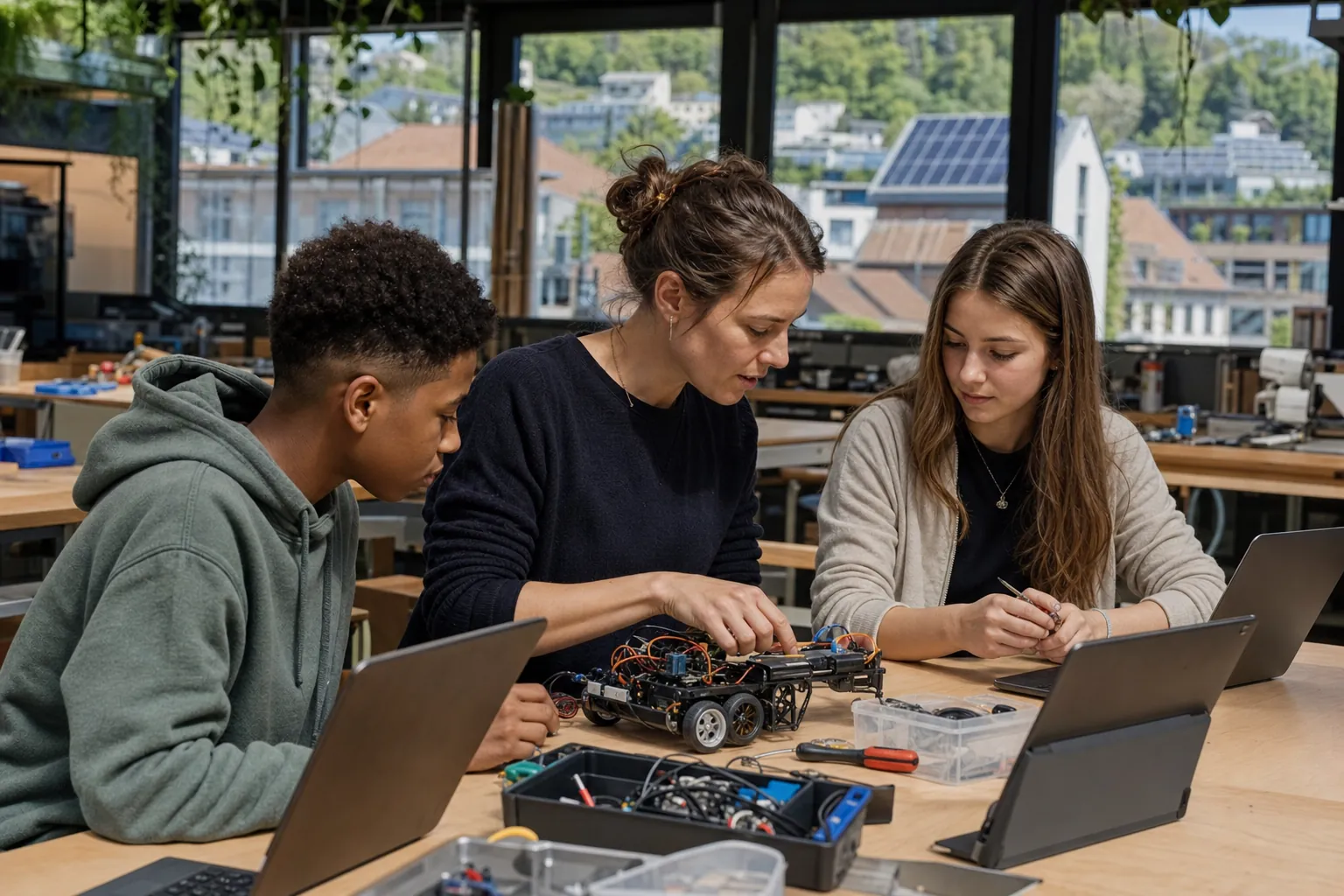
Where do things stand today, and where do they break?
Education today is primarily a Front-Loaded Model: 12 to 18 years of school and university, then a lifetime of paid employment, with occasional further training. In Switzerland, about 65% of adult education is financed by employers or privately; the state's share is below 15%. Further training at age 45 and above is statistically rare: over 60% of people aged over 45 take no formal further training in any given year. Universities see themselves primarily as initial-education institutions rather than lifelong-learning hubs. EdTech platforms (Coursera, edX, Udemy) are growing but remain fragmented in the B2C market; an institutional anchor is absent.
If AI materially reshapes occupational profiles every five to seven years, the front-loaded model faces a structural crisis. A 30-year-old with a university degree from 2026 will, in all likelihood, navigate three to five Career development training need. Not one retraining course per decade but one every five to seven years. Those who must fund it themselves will fail. Those who skip it will lose economic participation. At the same time, the question of Human Premium is becoming urgent: which human capabilities remain structurally relevant when AI produces knowledge? Empathy, judgement, meta-learning, social trust. None of these is fostered by conventional curricula.
Paths out of the crisis
The stars show how realistic a path is: 1 star = barely feasible, 5 stars = highly feasible.
Learning account model (Singapore SkillsFuture logic)
A lifelong learning account for every citizen: state-financed, individually managed, and tied to accredited providers.
+ Structural, individual, market-friendly.
Fiscally substantial (~CHF 3.5bn p.a. at CHF 80,000 per citizen over 30 years).
Trade-off: Public funding vs. private provider diversity.
Feasibility: Singapore's SkillsFuture programme, in place since 2015 with an initial ~SGD 500 plus annual top-ups, has achieved high adoption rates. Switzerland has the fiscal headroom and the federal experience with education investment. Politically viable if coupled with AHV reform.
Retraining insurance (mandatory or voluntary)
Insurance against skill obsolescence. Contributions are paid out on proof of retraining.
+ Risk-based, market-consistent.
Adverse selection likely.
Trade-off: Efficiency vs. universality.
Feasibility: Unemployment insurance (ALV) is conceptually a forerunner. Extending it to retraining is conceivable but technically complex: when does a retraining measure count as "sufficient"?
Universities as lifelong-learning hubs
Universities shift their business model from initial education to continuous support across working lives.
+ Leverages existing infrastructure.
Cultural change in universities is slow.
Trade-off: Tradition vs. transformation.
Feasibility: EPFL Extension School and ETH Continuing Education are exemplars. Scaling is feasible but requires universities to direct 30 to 40% of their teaching capacity towards adults. That is a substantial shift.
AI tutoring as core infrastructure (Khanmigo model)
Personalised AI learning partners for every citizen — publicly funded, methodologically transparent.
+ Scales without teaching-staff bottlenecks.
Educational quality not guaranteed.
Trade-off: Scalability vs. human mentoring.
Feasibility: Khan Academy and Anthropic's partnership as a proof of concept (Khanmigo, 2024+). Early studies show empirically strong learning gains. A Swiss variant with data-protection guarantees and a multilingual foundation model would constitute an investment in public infrastructure.
Educational commons / open-source curricula
Teaching materials, curricula, and assessment standards as a digital commons: freely licensed and collectively maintained.
+ Democratises educational content.
Quality assurance difficult.
Trade-off: Openness vs. standardisation.
Feasibility: OER (Open Educational Resources) since 2002, with MIT OpenCourseWare as the benchmark. Functions as a complement to, not a replacement for, institutional education. Vital for democratic accessibility.
Trigger-based phases
Trigger: The first Swiss cantons are piloting learning accounts at pilot scale (10,000–50,000 citizens).
2027–2029. Geneva, Zug and Vaud as frontrunners. Initially CHF 5,000 per citizen plus CHF 800 annually, tied to accredited providers. In parallel, a Swiss AI tutoring initiative is being led jointly by the Confederation, ETH and EPFL.
Trigger: Popular referendum or federal resolution on a nationwide learning account.
2029–2033. Nationwide roll-out. CHF 8,000 initial grant, CHF 1,200 annual top-up, approximately CHF 80,000 available over a lifetime. AI tutoring platform goes live; universities announce lifelong-learning programmes.
Trigger: More than 35% of university teaching is oriented towards lifelong learning.
2033–2038. Universities shift their business models. Micro-credentials become the norm. Retraining at 45+ becomes a cultural norm. Vocational education is augmented by AI. Human-premium disciplines are strengthened within curricula.
Trigger: Lifelong retraining is normalised; more than 70% of those aged 35 and over take up educational services each year.
2038+. Education is infrastructure, like electricity or water. AI tutoring is the standard, learning accounts are universally available. Human Premium has established itself as a focus within education. The Swiss system is the European model.
Real-world pilot programmes
Where the ideas behind this pillar are already being tested. "Learn more" opens the explanation without leaving the page.
What we are watching
Retraining as a cultural norm. The 70% threshold marks the end of the front-loaded model.
Track in the index →Universities as lifelong learning hubs. The 35% threshold means that more than one third of teaching provision is directed at adults beyond the age of 30.
AI tutoring as standard infrastructure. A threshold of 60% means universal availability — not confined to premium charter schools.
The dominance of degree-based qualifications is giving way to modular accreditation. A threshold of 50% means that half of all formal educational recognition is granted through modular pathways.
Our assessment
At Globalance, we consider the learning-account model the structurally cleanest path. Not because it is the simplest option, but because it institutionalises the infrastructure logic. Education is publicly secured across the entire lifespan, individually directed, and delivered through the market. Singapore has demonstrated that this works; Switzerland has the fiscal and institutional conditions to do it larger and more consistently.
In concrete terms: A Swiss learning account with an initial endowment of CHF 8,000 at age 18, plus annual top-ups of CHF 1,200. Over 50 years, this amounts to approximately CHF 80,000 in lifelong education budget. The fiscal burden of approximately CHF 3.5bn p.a. is manageable (equivalent to approximately 0.4% of GDP) and is largely offset by higher labour-force participation and a broader tax base.
AI tutoring as a supplementary layer of infrastructure is the key to scalability. Khanmigo (Khan Academy + Anthropic) shows that personalised AI learning partners can achieve learning gains empirically equivalent to those of one-to-one tutoring, at a fraction of the cost. A Swiss variant with a GDPR-compliant foundation model and multilingual design (German, French, Italian, English) would be an investment in public infrastructure that pays for itself within five years.
Universities must reinvent themselves: from initial-education provider to lifelong-learning hub. EPFL Extension School and ETH Continuing Education point in the right direction, but are too small. The goal: 30–40% of course provision for adults over 30, modular micro-credentials rather than only bachelor's and master's degrees, affordable part-time programmes for working professionals. Universities that do not make this shift will face structural pressure within 15 years.
The Human Premium lies in four areas that remain structurally resistant to AI: Empathy and social trust (care, therapy, leadership), Judgement under uncertainty (strategic decision-making, ethics, law), Meta-learning and reframing (innovation, research, creative synthesis), cultural and contextual depth (Arts, diplomacy, local expertise.) Education must nurture these fields systematically rather than relegating them to the margins of the curriculum.
What this means for investors: First, lifelong learning becomes a permanent imperative. Providers of further education, learning platforms, and certification benefit if public learning accounts are introduced. Second, AI tutors substantially reduce the cost per learning hour. Those whose business depends on expensive in-person education will need to adapt their model. Third, companies with a strong internal learning culture retain skilled staff longer, which shows up in lower staff turnover costs. Fourth, capabilities that AI does not replace gain in value: judgement, leadership, ethics. This applies equally to the assessment of teams and management.
Why now: We are in the window during which the AI substitution wave is making the education gap visible, yet before it has escalated into a political crisis. Within five to seven years the gap will be unmistakable; by then, education reform will only be possible reactively. Those who build the learning account and the AI-tutoring infrastructure now will hold a competitive position in the next phase.
The strongest objection is empirical. Further education is least used precisely where it is most needed: those already well qualified take it up; those being displaced do so less often. A learning account changes the financing, not this pattern. Those who consider it sufficient assume a demand that does not yet exist; those who reject it on these grounds have no better instrument. The open question is not the money but how retraining at 55 becomes a path people choose freely.
What we do not yet know
- How does one balance the universality of a learning account with provider diversity? Who accredits, and who controls?
- Should the AI tutoring system be run by the state, by private operators, or as a public–private partnership?
- How do we prevent micro-certificates from driving inflation and a decline in quality?
- What is the role of traditional university degrees in a world of modular, lifelong learning?
Connected to: 04 · Labour, 07 · Data & AI, 10 · Purpose
Scenarios: Labour & Automation · Technology & AI · Society & Psychology